

2024.03.25 JAAA Paper Summary (English)

The Japan Advertising Agencies Association (JAAA) holds an annual competition for members' employees, inviting submissions of "practical essays" and "opinions." On March 25, 2024, the winners of the 53rd competition were announced. The top prize, the Gold Award, was awarded to Hiroyuki Miyai, Director of the Future Business Office at Hakuhodo JV Studio, for his essay titled "Consumers Become Advertisers, and Society Itself Becomes the Media: Ensuring the Advertising Industry Remains Essential in the Age of Singularity." Regarding the background of his essay, Mr. Miyai commented as follows.
第53回JAAA懸賞論文の金賞が発表に 『生活者は広告人となり、社会そのものがメディアとなる〜シンギュラリティ時代に広告が欠かせない産業になるために〜』
日本広告業協会(JAAA)では毎年、会員社社員を対象に「論文」と「私の言いたいこと」の懸賞募集を実施している。
https://www.advertimes.com/20240325/article452912/

Background

The concept of the Singularity, introduced by Ray Kurzweil, was initially predicted for 2045. This estimate seemed premature at the time. However, the rapid adoption of ChatGPT, reaching 100 million users in just two months, and the practical implementation of AI technologies for images, audio, and videos have brought the Singularity closer. As Peter Diamandis, President of Singularity University, points out, the convergence of these technologies accelerates change, leading to disruptive transformations. The Singularity is indeed "quite near." How should advertisers respond to this rapid societal shift? I see it as an era where human creativity takes center stage. To remain vital in this new age, the advertising industry must leverage our skills and redefine our approach. This paper is written with that perspective in mind.

Summary

1️⃣
As the Singularity becomes a reality, I view this era as one where human creativity will be further highlighted. The purpose of this paper is to define a new overall vision of advertising, based on societal trends and issues, and discussions from past JAAA communities, and to outline the path toward its realization.
2️⃣
First, I reviewed past JAAA papers, using the AMA's definition of advertising as a reference. The results showed the following:
  1. From the perspective of the recipients of advertising, there is a decline in the significance of advertising, the need to utilize information technologies such as AI, and the necessity of rulemaking.
  2. From the perspective of messages and media, there is a need for corporate intent, ethics, solidarity among people, and contributions to societal well-being.
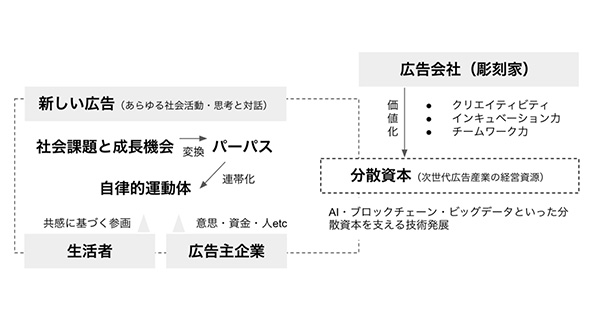
  3. From the perspective of advertisers and advertising agencies, creativity, incubation, and teamwork are identified as the three key sources of value creation.
3️⃣
Next, I attempted to structure a new vision of advertising using analogy thinking, drawing on the concept of social sculpture discussed through the works of German sculptor Josef Beuys. This concept involves shaping and transforming society through collective creativity and participation. From the hypothesis "advertising becomes like social sculpture," we derived the following five manifestos for the new vision of advertising:
  1. Consumers are also advertisers, and everyone possesses creativity.
  2. Our thoughts and dialogues are processes that constitute advertising.
  3. Society, as a whole, is a single medium.
  4. All our activities can become advertising messages.
  5. Advertising must be purpose-driven.
Finally, I proposed a roadmap for realizing the new vision of advertising, inspired by the Web3 worldview of "decentralization from centralization." We suggested that advertisers take on the role of "sculptors," guiding individuals and organizations working autonomously toward solving societal issues. This involves transforming social challenges and growth opportunities into purpose-driven actions through creativity (verbalization and visualization skills), uniting consumers and companies through teamwork, and facilitating communication activities internally and externally via incubation to promote decentralization.

I refer to the state where AI and various technologies are utilized to add value to this entire series of elements as "decentralized capital," which we believe will become the management resource for the next-generation advertising industry. Advertising agencies will create trust points through communication activities that ensure the aggregation of distributed capital, mediate the exchange of various values within the distributed capital, and earn revenue shares.

In summary, I propose a new definition of advertising: "Advertising is a continuous socio-economic activity and its executing organization, designed with the purpose of solving future societal challenges and seizing growth opportunities. Advertising is promoted as a decentralized co-creative activity by the involved organizations and individuals."